



Sometimes up, sometimes down: How capital’s seesaw
reshaped everyday life at Budapest’s former Ganz-MÁVAG site
by Márton Berki and Mirjam Sági
Investment is usually associated with progress, while disinvestment is understood as decline. Yet places do not move “up” or “down” in the same way for everyone. Our study of Budapest’s former Ganz-MÁVAG manufacturing site shows that capital’s movements are lived through jobs, routines, memories, emotions and changing senses of belonging. The same transformation may bring security to some, loss to others and opportunity to others.
Capital’s seesaw
Our starting point is Neil Smith’s metaphor of the seesaw of uneven development. Capital repeatedly moves between places in search of more profitable opportunities. Investment develops certain locations, but capital may later move elsewhere, leaving behind devalued spaces that can eventually become attractive for renewed investment.
The Hungarian saying egyszer fenn, máskor lenn – “sometimes up, sometimes down” – captures economic and emotional trajectories alike. This double meaning allows us to connect the political economy of uneven development with the ways in which structural change is experienced in everyday life.
From industrial giant to brownfield
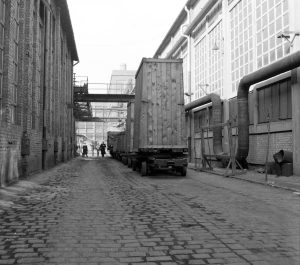
Located on the boundary of Budapest’s Districts VIII and X, the Ganz-MÁVAG site was once one of Hungary’s largest industrial complexes. After the merger of Ganz and MÁVAG in 1959, it employed around 20,000 people across a 42-hectare site.
Heavy state investment during the 1950s and 1960s placed the factory firmly “up” on the seesaw. It offered relatively secure employment and became an important centre of working-class life. From the 1970s onwards, however, declining innovation and competitiveness pushed it downward. Ganz-MÁVAG ceased to exist in 1988 – before the socialist system itself collapsed. For many former workers, 1988 was what 1989 was for the country: the moment when a familiar world began to disappear.
During the following two decades, much of the factory became a devalued brownfield. Disinvestment meant more than decaying buildings. It also involved the loss of workplace communities, factory routines and welfare arrangements that had organised everyday life.
Being “up” was never the same for everyone
A central argument of our study is that upward and downward positions are never absolute. State-socialist industrial development provided material security and generated pride and attachment. Yet this supposedly “upward” period was also experienced through political constraint, bureaucratic frustration and weakening community ties.
The experiences of Roma workers make this relational character especially visible. During the 1970s and 1980s, many established non-Roma workers saw the factory as stagnating and losing prestige. For Roma people arriving from economically marginalised regions of Northern Hungary, however, industrial employment could represent upward mobility and greater security. What appeared as decline from one social position could be experienced as improvement from another.
The return of capital – in a different form
Capital eventually returned, but not through the revival of large-scale industrial production. From the 2000s onwards, Chinese traders from the neighbouring Four Tigers market began using empty factory halls for storage and wholesale activities. After that market closed in 2013–2014, commercial activity moved more decisively into the former industrial complex. Chinese, Vietnamese, Turkish, Afghan and other traders gradually transformed it into what is now widely known as Budapest’s Chinatown.
Buildings were reused, trade expanded and new services appeared. Yet the form of reinvestment matters. The new “upward” trajectory was based not on industrial employment and collective welfare infrastructures, but on trade, logistics, retail and small-scale transnational investments. Reinvestment should therefore not automatically be equated with recovery.
The transformation also produced conflicting interpretations. During the 1990s and 2000s, narratives of dereliction, insecurity, disorder and cultural distance dominated. Chinese traders were often represented as a closed community and the market as an unfamiliar “parallel world”. Such narratives drew symbolic and ethnic boundaries between those imagined as belonging to the neighbourhood and those constructed as outsiders.
From the mid-2010s onwards, more neutral and positive framings emerged. Nearby residents increasingly stressed the market’s wide selection and low prices. In one of Budapest’s poorer areas, it became part of an informal local social safety net. Alternative urban walks and gastronomic programmes have also begun presenting the site as a “hidden gem”.
The former factory is thus seen as both rundown and exciting, marginal and increasingly fashionable.
Bringing uneven development into everyday life
We combined document and discourse analysis with conventional interviews, informal conversations, a museum interview and mobile, or “go-along”, interviews. Walking with participants proved especially valuable: buildings and encounters prompted memories and emotions that might have remained hidden in a seated interview.
This approach allowed us to connect Smith’s political-economic theory with Henri Lefebvre’s distinction between abstract space and the space of everyday life. Capital may treat the site as an investable, devalued or revalorised location. For those who work, live or move through it, however, it is simultaneously a landscape of security and insecurity, pride and shame, attachment and estrangement.
The seesaw is therefore not simply an economic model. It is also an emotional, moral and identity-related movement whose effects are classed, ethnicised and spatialised.
What kind of “upward” movement?
The Ganz-MÁVAG case challenges the assumption that renewed investment is inherently beneficial. Capital’s return may increase economic activity and transform an abandoned landscape while also producing exclusion, unfamiliarity and displacement.
The critical question is not simply whether a place moves upwards or downwards. We must also ask: What kind of capital is arriving? What forms of work and everyday life does it create? Who benefits – and who no longer feels at home?
The form of reinvestment matters at least as much as its magnitude. Only by examining its lived consequences can we understand what being “up” or “down” actually means—and for whom.
 This post draws on Márton Berki and Mirjam Sági’s article published in the Hungarian Geographical Bulletin, 75(2), 165–179.
The research was carried out within the NKFIH-funded project “Marginalised Space Experience in the Context of Uneven Geographical Development” (Grant No. K 138713).
