



Good Enough for a Home?
How EU-Funded Housing Decides Who Deserves It
Tünde Virág
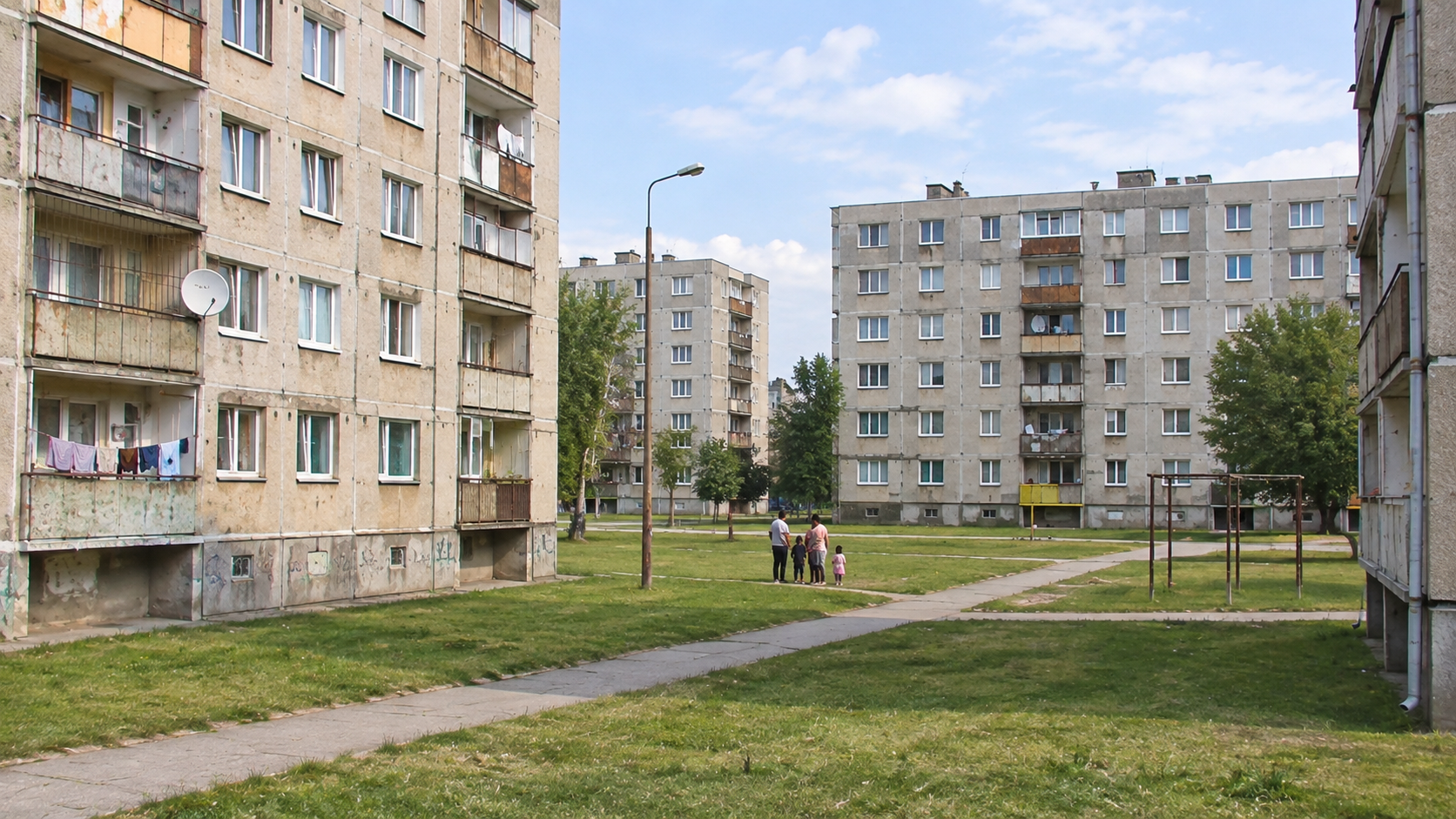
Development programmes promise inclusion. Too often, they deliver displacement, stigma and new forms of exclusion. We usually blame programme design, weak institutions or a lack of political will. But what happens after a programme leaves Brussels and Budapest and lands in a small town? My recent Geoforum article follows an EU-funded housing programme in a resource-poor Hungarian town with a significant Roma population and asks who decides, and how, once the money arrives.
Development is not implemented; it is translated
The article develops the concept of everyday statecraft: the routine practices through which municipal officials, intermediary organisations, street-level professionals and residents interpret, negotiate and materially enact development. Governmental objectives do not simply trickle down. They are continually translated across macro, meso and micro scales into locally legitimate forms of rule. National “catching up” discourse and the work-based society paradigm meet local ambitions on the ground. In this town, that meant sustaining the middle class in a shrinking community while governing racialised poverty through administrative constructions of deservingness.
Housing is more than bricks and rent
I consider housing social infrastructure, a system that assembles material provision, governance practices and social relations. It is where governmental rationalities take spatial form. In this town, public housing sorts people. Fully equipped flats in the centre serve the working middle class, halfway housing supports young “deserving” couples, and those labelled problematic or undeserving are allocated low-quality flats, shelters and temporary homes on the outskirts.
Brokers hold the keys
Crucially, translation does not happen by itself. Social workers, housing officers, committee members and local politicians stand between programme rules and local applicants. Their everyday administrative practice turns discretion into institutionalised governance. The selection criteria for the new social housing were set out. Yet applying them required negotiation, recommendation and sometimes overruling, and the committee’s final list did not always align with the social workers’ recommendations. In the end, brokers decided which families were cooperative, reliable and trustworthy.
Inclusive goals, conditional inclusion
The programme targeted the town’s most marginalised residents. Yet only families deemed “good enough Roma” were allowed to move into the new social housing. The “good Roma” is not a pre-existing category. It is produced through daily encounters and routine decisions, and it becomes the operative figure through which belonging is conditional. Those left out could still receive other help, such as crisis housing or work, but exclusion was reframed as individual failure rather than structural inequality.
The result is conditional citizenship: access to housing and welfare depends on behavioural conformity, bureaucratic legibility and ongoing surveillance. This is not a failure of implementation. It is the outcome of everyday statecraft.
How the local state is made
The state is a dispersed assemblage whose discretionary choices decide who gets public resources. Through acts of interpretation, brokerage and classification, political choices become administrative common sense. This is how development helps produce the local state and perpetuates social hierarchies while still promising inclusion.
Why it matters
If we want to understand why inclusion-minded development so often reproduces inequality, we should look beyond programme design. The answer lies in the everyday work of translation, which decides who gets a home and who is left waiting.
 Read the full article: Virág, T. (2026).
Development in translation: everyday statecraft, housing as social infrastructure, and the production of racialised deservingness.
Geoforum, 177, 104825.
https://doi.org/10.1016/j.geoforum.2026.104825