



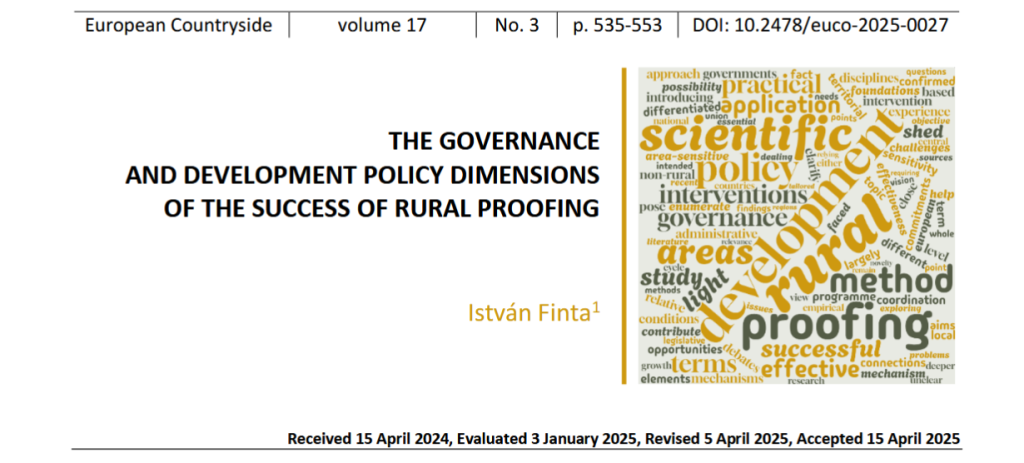
Territorial sensitivity and the different treatment of rural areas’ needs over the past two to three decades have given rise to an intervention and governance method in many countries known as rural proofing. The practical significance of this approach is also supported by the fact that the European Commission has incorporated it into the Long Term Vision for Rural Areas and has committed to implementing this approach at EU level within the framework of “good governance.” and has asked Member States to consider adapting the principle of rural proofing at national, regional, and local levels. At the EU level, rural proofing means reviewing policies from a rural perspective to ensure that they meet the needs of people living and working in rural areas. In practice, for policies under development, it takes into account the actual and potential, positive or negative, direct and indirect impacts and consequences on rural jobs, development prospects, social well-being, equal opportunities for all, and the environmental quality of rural areas and communities.
Rural proofing has been applied to date – at different times and in different forms – in England, Northern Ireland, Finland, Sweden, and outside Europe in Canada, Australia, parts of the USA, and New Zealand.
Rural proofing initially meant impact assessment, but now it means interventions based on distinctive characteristics. The history of rural proofing also shows that the essence of the method can no longer be limited to rural areas alone, but – with a focus on local and regional characteristics – it can also become an effective intervention tool for non-rural areas, provided that the conditions for its successful operation are substantiated by research.
A distinctive feature of the study is that it primarily presents the legal and administrative dimensions of this governance method development policy tool, which have not been the focus of either policy or scientific research to date. The novel approach to the topic can be summarized in that its starting point is not traditional impact analysis and checklists (what may or may not have an impact on rural areas), but rather a mechanism based on the administrative cycle, with the aim of developing cooperation between sectors and implementing an integrated approach.
The study has set itself at least three objectives. First, it seeks to explore the deeper scientific connections that can bring us closer to understanding the nature and characteristics of rural proofing. Second, it aims to identify the conditions that, based on experience to date, appear to be essential for the successful application of this approach. Third, using the example of a unitary, centralized state (Hungary), it seeks to show which conditions for the successful application of rural proofing are already in place and which still need to be worked on if there is a genuine intention to apply this approach.
Of course, the findings are not intended to close the debate, but rather to shed new light on the conditions for the functioning of rural proofing, which will contribute to further scientific debate and to the development of a much more effective central and regional intervention mechanism.
 Reference:
Finta, István. “The Governance and Development Policy Dimensions of the Success of Rural Proofing”
European Countryside, vol. 17, no. 3, Mendel University in Brno, 2025, pp. 535-553.
https://doi.org/10.2478/euco-2025-0027
