



Why Zambia’s rice policy needs more than irrigation infrastructure
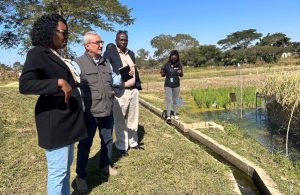 In many low-income countries, agricultural transformation is constrained not only by land and labour, but by water. This is increasingly true in Zambia’s rice sector, where climate variability, weak infrastructure, and fragmented value chains combine to limit productivity and resilience. Our recent FAO study on paddy water management in Zambia makes an important contribution by showing that irrigation is not simply a technical investment. It is part of a broader institutional and socioeconomic challenge that links farmer capabilities, gender inequality, risk management, and market development.
This is an important finding because rice occupies a potentially strategic place in Zambia’s agricultural development. Demand is increasing, especially in urban areas. Rice can contribute to crop diversification, reduce dependence on imports, and generate cash income for rural households. Yet domestic production remains weak. Average yields are only around 1.0–1.1 tonnes per hectare, well below the estimated break-even level of 1.6–2 tonnes per hectare. In other words, many smallholders are producing below commercially viable thresholds, despite Zambia’s considerable land and water endowments.
The reasons are not difficult to identify. Production is still overwhelmingly rainfed. Access to irrigation remains limited. Certified seed use is low, mechanization is minimal, and farmers often sell unmilled paddy into poorly structured markets at low farmgate prices. These are familiar problems in agricultural development: where input systems are weak, extension is thin, and markets do not reward quality, productivity remains low even when natural potential is high.
The study is valuable because it moves beyond a simple diagnosis of “low productivity” and examines the mechanisms that sustain it. Based on a survey of 300 rice farmers across three provinces, the report analyses farmer heterogeneity, disaster exposure, risk perceptions, and willingness to adopt irrigation. This matters because rice farmers in Zambia are far from homogeneous. They differ across regions, floodplain and upland ecologies, experience levels, input use, access to infrastructure, and market participation. Averages obscure these differences. Good policy cannot afford to do the same.
One of the report’s strongest findings is that climate risk is already central to production decisions. Farmers reported recurrent exposure to both droughts and floods over the past decade. In dry years, rice profitability can turn negative. This is a crucial point. For smallholders operating close to subsistence constraints, production shocks are not merely temporary fluctuations. They can undermine the incentive to invest, weaken commercialization, and encourage retreat into lower-risk but lower-return activities.
In this context, irrigation appears to offer a clear pathway forward. The pilot evidence in the study is striking. Controlled irrigation generated around 50 percent higher profits than uncontrolled irrigation under the same production conditions, and substantially outperformed rainfed methods. Controlled irrigation also improved water-use efficiency, producing better yields with less water than constant flooding. These are exactly the types of gains that make irrigation an attractive policy instrument in the face of climate stress.
But the central message of the report is that infrastructure alone is not enough.
This is perhaps the most policy-relevant insight. Farmers often do not perceive irrigation as strongly linked to yield gains or climate resilience, even though technical evidence shows otherwise. This disconnect reflects a broader problem in rural development: productive technologies are not adopted automatically just because they are profitable in principle. Adoption depends on knowledge, trust, demonstration effects, training, and institutional support. When these are weak, public investment risks underperforming.
The report therefore points to a classic complementarity problem. Irrigation infrastructure must be combined with what might be called “soft investments”: farmer training, technical extension, local water management knowledge, and access to climate information. Without these, irrigation systems may remain underused, mismanaged, or unsustainable. This is especially important in contexts such as Zambia, where rice production is still relatively new and many farmers have not yet developed stable, locally adapted production practices.
The gender dimension is equally important. Women are central to agricultural labour in Zambia, yet the study finds that they are less willing to adopt irrigation than men, even when drought exposure increases. This is not because women are less affected by climate risks. Rather, it reflects structural inequalities in access to land, information, resources, and decision-making authority. Here again, the lesson is familiar but too often ignored: technology adoption is shaped by institutions and power relations, not just by agronomic need.
This has direct implications for policy design. Irrigation programmes that are formally gender-neutral may reproduce unequal outcomes if they fail to address the specific barriers women face. The report is right to emphasize women-focused training and targeted support. Expanding irrigation without addressing inequality will narrow neither the productivity gap nor the resilience gap.
Education shows a similar pattern. More educated farmers are more willing to adopt irrigation, particularly as exposure to drought rises. This suggests that the returns to irrigation policy depend partly on farmers’ ability to process information, evaluate risk, and manage new systems. It also shows why resilience should not be understood narrowly as infrastructure provision. Human capital matters. Learning matters. Information matters.
The broader contribution of the study is that it embeds irrigation within the rice value chain rather than treating it as a standalone investment. This is exactly the right perspective. Smallholder productivity is rarely constrained by one missing factor alone. Irrigation may stabilize water supply, but its full impact will remain limited if seed systems are unreliable, extension is weak, mechanization is absent, and post-harvest systems are underdeveloped. Likewise, higher production does not automatically translate into higher income when farmers are forced to sell paddy into fragmented and low-value markets.
This implies that Zambia’s rice policy should be integrated in two senses. First, irrigation development must be integrated with training, extension, farmer organizations, and climate information systems. Second, it must be integrated with value chain development, including input supply, processing, storage, and market access. Only then can productivity gains be converted into income gains and sustained commercialization.
There is also a wider lesson here for agricultural policy in Africa. Too often, public debates frame development choices as a matter of selecting the right technology. But the real challenge is usually institutional: how to create the conditions under which technologies are adopted, adapted, and used productively. The Zambian case illustrates this clearly. The binding constraint is not simply the absence of irrigation hardware. It is the absence of a coordinated system linking infrastructure, incentives, capabilities, and markets.
In that sense, this study offers more than recommendations for Zambia’s rice sector. It illustrates how applied research can help shift policy away from narrow input-based thinking and towards a more systemic view of agricultural transformation. Irrigation matters. But it matters most when embedded in institutions that enable farmers to use it effectively, equitably, and profitably. That is the real policy challenge.
Pek, E., Salman, M., Fertő, I., Bakucs, Z. & Mukanga, M. 2026. Evidence-based analysis for integrating improved and multifunctional paddy water management into policy frameworks in Zambia – Socioeconomic profiles, risk perceptions and practice preferences of smallholder paddy farmers. Rome, FAO.
https://doi.org/10.4060/cd8904en
