



Efficiency in the Olympic Games:
The Role of Mobility and Inequality
by Gergely Csurilla, Imre Fertő and Lajos Baráth
The Olympic Games are usually discussed through medal tables. Countries are ranked by the number of gold, silver and bronze medals they win, and public attention naturally focuses on the nations at the top. But this familiar ranking hides an important question: which countries make the most efficient use of the resources they have?
A large economy and a large population clearly help in Olympic competition. Wealthier countries can invest more in coaching, facilities, sports science and athlete support, while larger countries draw from broader talent pools. Yet Olympic success is not only about how many resources a country has. It is also about how effectively those resources are converted into sporting performance.
 Our recent study, published in the Journal of Sports Economics, examines precisely this question. Instead of asking only who wins the most medals, we analyse how efficiently countries transform economic, demographic and sporting resources into Olympic results. The study covers the Summer Olympic Games from 1996 to 2020 and introduces a broader performance measure that rewards not only medals, but also near-podium finishes.
Looking beyond the medal table
Traditional Olympic rankings are simple and intuitive, but they can be misleading. A country that wins many medals may still be underperforming relative to its resources, while a smaller or less wealthy country may achieve impressive results given its economic and demographic constraints.
To capture Olympic performance more precisely, we use a weighted Olympic score. Gold, silver and bronze medals receive the highest weights, but fourth, fifth and sixth places are also included. This matters because near-podium finishes often reflect a country’s competitive depth, even when they do not appear in standard medal tables.
This approach allows us to move from a simple count of medals to a richer measure of sporting achievement. It recognises that Olympic performance is not only about standing on the podium, but also about consistently reaching the highest levels of international competition.
Measuring Olympic efficiency
The study applies a stochastic frontier model, a method widely used in economics to measure efficiency. In simple terms, the model estimates what level of Olympic performance should be attainable for a country given its resources, and then compares actual performance with that benchmark.
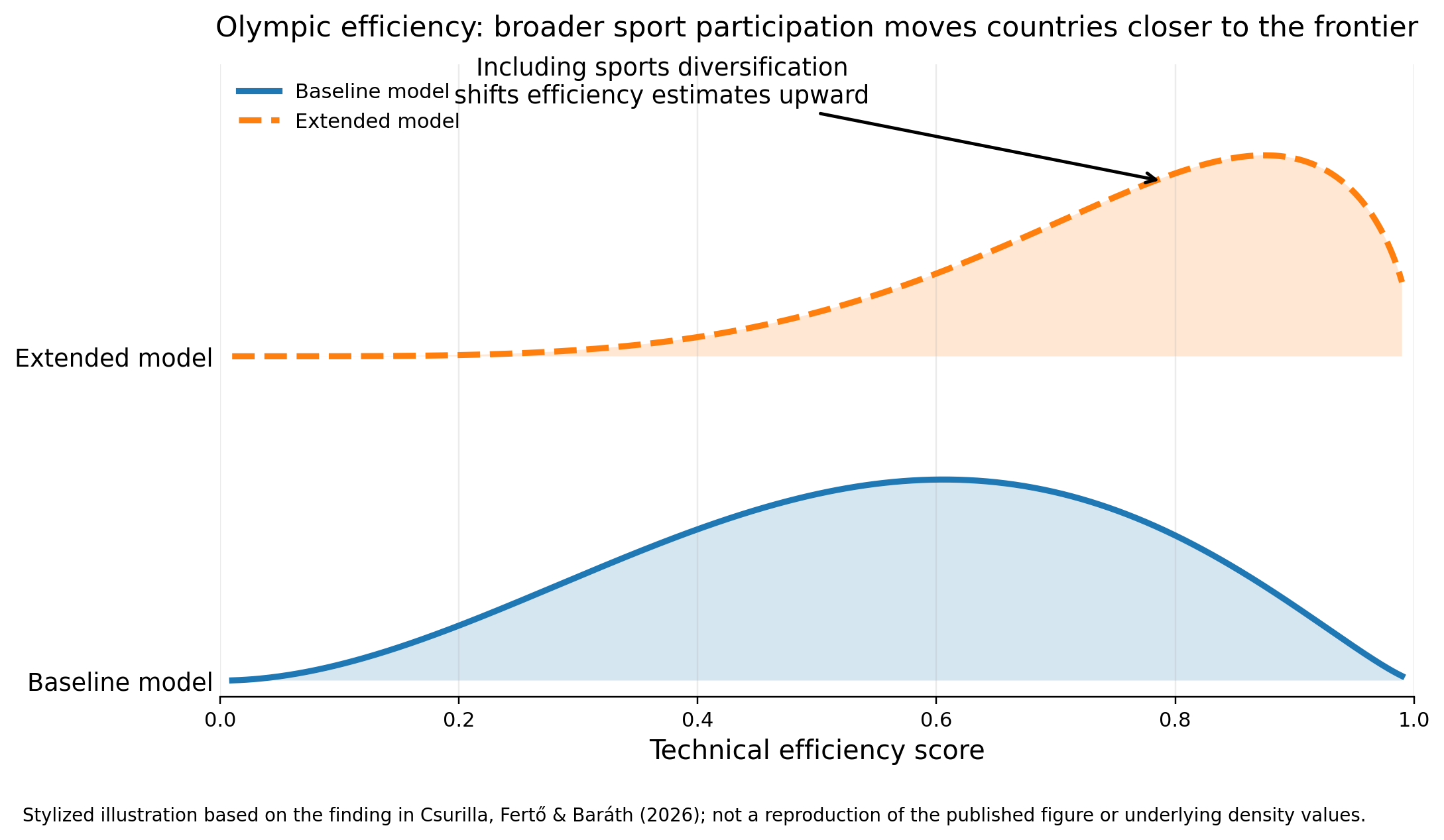
This makes it possible to distinguish between countries that simply have large resource bases and countries that use their resources particularly well. The average technical efficiency score in the study is around 0.68, suggesting that countries operate, on average, at about 68 percent of their estimated Olympic performance frontier. Put differently, there is substantial room for many countries to improve performance without necessarily increasing resources.
Importantly, the analysis allows the “technology” of Olympic success to differ across countries. This is crucial because national sport systems vary widely. Countries differ in their institutions, sport cultures, talent development systems, funding models and strategic priorities. A single universal model of Olympic success would therefore be too restrictive.
Why diversification matters
One of the central findings of the paper concerns sports diversification. We examine whether countries perform more efficiently when they participate across a broader range of Olympic sports.
The results show that diversification matters in two ways. First, entering more sports is associated with higher potential Olympic output. Second, broader participation is linked to lower inefficiency, meaning that countries with more diversified Olympic participation tend to operate closer to their performance frontier.
This does not mean that every country should invest equally in every sport. For smaller or resource-constrained nations, highly selective strategies may still be rational. However, the results suggest that, on average, countries with broader sporting portfolios are better positioned to convert resources into Olympic success.
Diversification may reduce dependence on a narrow set of disciplines and make national performance less vulnerable to injuries, changes in qualification rules, or fluctuations in a few events. It may also reflect deeper institutional capacity: countries able to support athletes across many sports may have more developed systems of coaching, talent identification and sport governance.
Inequality and mobility in Olympic efficiency
The paper also examines whether Olympic efficiency is becoming more equal across countries, and whether nations can move up or down the efficiency ranking over time.
The findings suggest modest but meaningful change. Inequality in technical efficiency declined slightly between 1996 and 2020. The decline is not dramatic, but it indicates that the distribution of Olympic efficiency has become somewhat more even.
At the same time, the analysis shows real mobility. Some countries that started in lower efficiency groups managed to improve their relative position, while the highest-performing countries remained relatively persistent. In other words, the Olympic efficiency hierarchy is not completely fixed, but neither is it fully fluid.
This is an important message for policymakers. It suggests that improvement is possible, especially for countries that begin from weaker positions. But it also shows that accumulated advantages remain powerful. Strong Olympic systems are difficult to catch, and the countries at the top tend to remain there.
Lessons for sport policy
The study offers several lessons for elite sport policy.
First, resources matter, but they are not enough. GDP and population are important predictors of Olympic performance, but countries differ substantially in how effectively they convert those resources into results.
Second, sport policy should pay attention to efficiency, not only medal counts. A narrow focus on medals may reward countries with large resource bases while overlooking smaller countries that perform exceptionally well relative to their constraints.
Third, diversification deserves careful consideration. Broad participation across sports appears to support both higher output and greater efficiency. This does not imply a universal strategy, but it does suggest that overly narrow specialization may carry risks.
Finally, policy design should be context-specific. The results show that countries do not all follow the same path to Olympic success. What works for a large and wealthy country may not be appropriate for a smaller country with fewer resources. Efficient Olympic performance depends not only on spending, but also on institutions, organization and strategic choices.
A final reflection
The Olympic Games will always be about medals, records and national pride. But behind the medal table lies a deeper economic question: how well do countries use what they have?
By shifting attention from total medals to efficiency, this study provides a different view of Olympic success. It shows that some countries are not merely winning because they are rich or populous; they are also effective at transforming resources into performance. Others may have untapped potential.
For researchers, the findings highlight the value of more flexible models and broader measures of sporting achievement. For policymakers, they suggest that Olympic success is not only a matter of spending more, but of building systems that use resources wisely.
 Publication: Csurilla, G., Fertő, I., & Baráth, L. (2026). Efficiency in the Olympic Games: The Role of Mobility and Inequality. Journal of Sports Economics. https://doi.org/10.1177/15270025261450150