



Unlocking Schoolyards for Greener and Healthier Informal Settlements:
Lessons from Nakuru, Kenya
Sharon Chebet Simotwo, Jenő Zsolt Farkas and György Csomós
Urban green spaces support physical activity, recreation, social interaction, and healthier urban environments. Yet their benefits are highly unequal. In rapidly growing informal settlements, dense construction, limited resources, and exclusion from formal planning often leave little room for parks and playgrounds.
Could existing schoolyards help address this shortage without requiring cities to acquire new land? A study of two informal settlements in Nakuru, Kenya, explores whether school grounds could be opened to residents outside school hours. Combining GIS analysis, field observations, and surveys, the research demonstrates considerable potential—but also highlights the need for clear rules, adequate security, and shared management.
Nakuru as a Case
The study focuses on Kaptembwa and Rhonda, two neighboring informal settlements with a combined population of more than 77,000. Although they occupy only 13.5% of Nakuru’s total informal-settlement area, they accommodate 43.6% of its informal-settlement population. This concentration has produced an exceptionally dense environment in which land for public amenities is scarce.
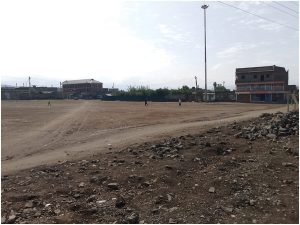
Official sources identify nine public open spaces in the settlements. Field observations, however, revealed that six were small, poorly maintained sites with limited vegetation and considerable waste, while two were fenced schoolyards. Only Mazembe Grounds in Rhonda was publicly accessible, but its dusty surface and lack of vegetation and park furniture meant that it offered few of the qualities normally associated with an urban green space.
How scarce are accessible green spaces in Kaptembwa and Rhonda?
The spatial and field analyses revealed several important findings:
- Almost no usable green space: Mazembe Grounds provides only 0.073 square meters of open space per resident. If its poor environmental condition is considered, the amount of space that could reasonably be classified as urban green space is effectively zero.
- Formal parks are too distant: Nakuru’s better-equipped parks and sports facilities are concentrated in formal parts of the city and cannot be conveniently reached on foot from Kaptembwa and Rhonda.
- Cost creates another barrier: Some parks and recreational facilities charge entrance fees, restricting their use by low-income residents.
- New parks are difficult to create: The dense urban fabric leaves little vacant land, making conventional park development expensive and potentially disruptive.
- Institutional land is underused: Schoolyards remain unavailable during evenings, weekends, and holidays, even though surrounding communities have almost no recreational space.
How much difference could schoolyards make?
The researchers identified ten schools — four public and six private — with potentially suitable schoolyards. Together, they cover 80,676 square meters. Opening all ten outside school hours would increase the total accessible open space, including Mazembe Grounds, to 86,296 square meters, or approximately 1.12 square meters per resident. This would represent a 15.3-fold increase over the current provision.
The four public schools alone account for almost 80% of the total schoolyard area. Opening only these grounds would still raise provision to approximately 0.90 square meters per resident.
Accessibility would also improve. Based on a 400-meter walking distance, the catchment areas of the schoolyards and Mazembe Grounds would cover 60.5% of the two informal settlements, bringing recreational opportunities within reasonable reach of many residents.
What did residents say?
A survey of 134 residents showed broad support for additional open spaces and the shared use of school grounds:
- Strong unmet demand: Only 36.6% regularly visited open spaces, but 89.6% said they would use them if more were available nearby.
- Support for shared use: Almost three-quarters agreed or strongly agreed with controlled public access to schoolyards outside school hours.
- Health and social benefits: Residents expected the initiative to encourage physical activity, improve well-being, strengthen school–community relationships, and provide safer play areas for children.
- Willingness to participate: More than 84% said they would contribute to a community initiative responsible for managing and maintaining the spaces.
What did teachers and experts say?
Teachers, public officials, planners, landscape architects, and academics also recognized the proposal’s potential, but stressed that opening the gates would not be enough:
- Security is the main concern: All stakeholder groups highlighted the risks of vandalism, theft, property damage, and unauthorized use.
- Access must be controlled: Schools would be more willing to participate if clear opening hours, supervision, and security measures were introduced.
- Responsibilities require clarification: Formal agreements should specify who maintains the grounds, supervises users, repairs damage, and assumes legal liability.
- Additional resources are necessary: Participating schools may need funding for maintenance, lighting, surveillance, equipment, and supervision.
- A pilot project is widely supported: Eighteen of the 19 experts favored testing shared public use at selected schools, while all participating teachers and experts expressed interest in further discussions.
Core dilemmas — opening schoolyards without creating new risks
The proposal illustrates a broader planning dilemma. Informal settlements urgently need recreational spaces, yet school grounds serve another essential function. Shared use could improve spatial equity, but poorly managed access might expose schools to additional costs and security risks.
There is also an important difference between an open area and a genuinely green, healthy, and welcoming place. Some schoolyards would require trees, shade, seating, safe surfaces, sanitation, and play equipment before they could function effectively as community spaces.
Nor would opening schoolyards solve the entire problem. Even if all suitable schools participated, nearly 40% of the settlements would remain outside the identified catchment areas. Shared schoolyards should therefore complement —not replace—long-term investment in public parks and green infrastructure.
What can be done?
Several measures could help turn the proposal into a workable initiative:
- Start with selected public schools: A limited pilot project should test controlled opening hours before wider implementation.
- Establish shared-use agreements: Education authorities, schools, local government, and community representatives should define access, liability, maintenance, and financial responsibilities.
- Combine security measures: Lighting, fencing, and controlled entrances should be supported by community patrols, local stewardship, and cooperation with community organizations.
- Improve schoolyard quality: Vegetation, shade, seating, sanitation, and durable recreational equipment would help transform basic grounds into attractive public spaces.
- Monitor the pilot: Visitor numbers, maintenance costs, security incidents, perceived safety, and effects on school operations should be regularly assessed.
- Explore alternative sites: Vacant land and other “opportunity spaces” should also be mapped to avoid relying on a single intervention.
Conclusion — seeing schoolyards as shared urban infrastructure
The Nakuru case shows that severe green space scarcity does not always mean usable land is entirely absent. Potentially valuable spaces may already exist within neighborhoods but remain inaccessible because they belong to institutions with other primary functions.
Opening schoolyards outside school hours could substantially increase recreational opportunities in Kaptembwa and Rhonda. The idea enjoys strong community support and could deliver health, social, and spatial benefits without the expense of acquiring land for new parks. Its success, however, depends on clear agreements, adequate financing, effective security, community participation, and careful monitoring.
The broader lesson for rapidly growing cities is that improving environmental justice may require not only creating new spaces but also rethinking how existing urban spaces are governed and shared.
 Sharon Chebet Simotwo, Jenő Zsolt Farkas, György Csomós:
Harnessing the potential of schoolyards to alleviate urban green space scarcity in informal settlements: case study using Nakuru, Kenya
Cities & Health, published online 30 June 2026
https://doi.org/10.1080/23748834.2026.2686825