



Rust and the risks of losing a corporate sponsor
Brigitta Németh and Johannes Wachs
Open source software makes its code available for others to use, modify and share. Many of these communities also rely on a company that helps develop the core technology and supports the wider ecosystem. What happens when that company withdraws? In our study, published in Technological Forecasting and Social Change, we examine Mozilla’s withdrawal as the anchor sponsor of the Rust programming language in August 2020. We find that the established core of developers remained resilient, while the entry of new contributors and projects slowed relative to earlier trends.
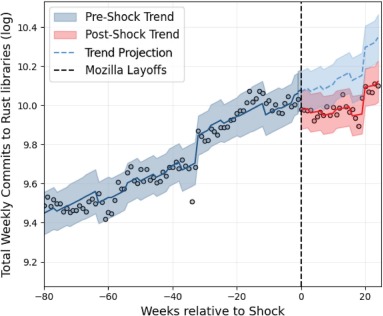
Mozilla, best known for the Firefox browser, incubated Rust and supported its infrastructure and community. We call such a firm an “anchor sponsor” because its role extends across an ecosystem of projects. Its backing may reassure developers that learning and building on the technology will be worthwhile. To examine changes around the layoffs of Mozilla’s Rust team, we analysed more than two million code contributions by over 25,000 developers. We compared activity after the withdrawal with projections based on earlier growth, accounting for seasonal patterns.
Immediately after the withdrawal, weekly code contributions fell by around 9%, and their growth trend weakened. Other forms of collaboration and discussion also declined. The clearest vulnerability concerned the ecosystem’s renewal: twenty weeks later, new developer entry and new project creation were both more than 20% below the levels projected from earlier trends. We found no statistically significant increase in developer departures or project abandonment relative to those projections. Existing development largely continued, while fewer new people and projects entered than expected.
The changes also depended on developers’ connections within the community. Activity among Mozilla-affiliated contributors initially fell sharply but recovered over the following months. Other contributors remained below their projected activity levels, with larger and more persistent shortfalls among those farther from Mozilla in the collaboration network. This pattern is consistent with established relationships and accumulated expertise helping sustain commitment. For less connected participants, the visible backing of a reputable firm may play a greater role in reducing uncertainty about an ecosystem’s future.
Rust continued to expand, and the Rust Foundation, established in February 2021, brought together several corporate backers. Our study captures the immediate transition and cannot isolate the withdrawal’s effects from the pandemic or other economic changes. It nevertheless identifies a risk that measures of ongoing development can miss: a community may keep working while attracting fewer new participants. For firms and policymakers supporting open source infrastructure, planning sponsorship transitions and monitoring newcomer entry deserve attention alongside maintaining existing projects.
 Based on Németh, B., and Wachs, J., “Anchor sponsor firms in open source software ecosystems: A case study of the Rust ecosystem,” Technological Forecasting and Social Change, 235, 124936. Published online 28 October 2026.