



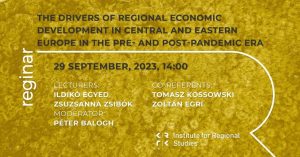
Reginar is the English-language online webinar of the Institute for Regional Studies. In this session, we can listen to the exciting discussion of four excellent scholars of economics and human geography.
Economic development in post-transition countries is dominated by the performance of capital cities, although second-tier cities are also important drivers of development. However, peripheral regions struggle with problems of adaptation and response, often leading to brain drain and economic decline. Industrial strategies highlight those tradable sectors of the economy that favour leading edge KIBS firms and advanced manufacturing, while neglecting the residentiary economy that is more sheltered from competition and provides jobs in local production and services sectors. Our research is inspired by the burgeoning literature of the ‘foundational economy’ approach to economic development, focusing on mundane economic activities providing essential goods and services, and we investigate the differences of economic performance across the NUTS3 regions in selected CEE countries. We study regionally aggregated, firm-level financial and employment data including sectoral classification of the companies with 10+ employees. Our position is that a well-functioning foundational economy is necessary for the whole local economy to work efficiently in the long run. Moreover, increasing productivity in the foundational economy should lead to more regionally balanced growth than an exclusive focus on the ‘frontier firms’ that are highly concentrated spatially as the regional productivity gap in the case of certain foundational activities is not necessarily large.
Lecturers: Ildikó Egyed, CERS IRS and Zsuzsanna Zsibók, CERS IRS
Co-Referent:
Tomasz Kossowski, UAM, Poznan
Zoltán Egri, MATE
Moderator: Péter Balogh, CERS IRS – ELTE
Date: 29 September 2023, 14:00


