



Out of School and Into Trouble? What Happened When Hungary Lowered the School Leaving Age – By Anna Adamecz, Dániel Prinz, Sunčica Vujić and Ágnes Szabó-Morvai

What happens when a government lets teenagers leave school earlier? In 2012, Hungary lowered the school leaving age from 18 to 16 for all secondary school students. The government hoped to ease the burden on the education system and to enable 16- to 18-year-olds who did not wish to continue school to seek employment, thereby increasing the supply of blue-collar workers. A recent study is the first to rigorously evaluate such a nationwide reform – and its findings offer a cautionary tale.
The Findings
Using a difference-in-cross-cohort-comparisons approach and linked administrative panel data on 235,598 individuals tracked monthly from age 15 to 19, the research shows that the reform sharply increased dropout rates: the probability of leaving school rose by 1.7 percentage points at age 16, by 5.5 percentage points at age 17, and by 4.3 percentage points at age 18. Crucially, leaving school earlier did not translate into more jobs. Employment in the open labor market did not increase in any statistically or economically meaningful way. Instead, about a tenth of those who dropped out ended up in subsidized public works schemes, while the rest were unemployed or inactive – the probability of being NEET (not in education, employment, or training) rose by 1.7 percentage points at age 16 and by 4.9 percentage points at age 17.
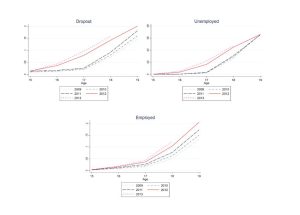
This graph shows that, compared to the years before the policy change (before 2012, blue and black lines), the dropout rates increased after the change (red lines) in all age groups affected by the change (above the age of 15). A similar jump in unemployment rates can be observed in these ages, but no significant change other than the trend can be observed in the employment probabilities.
Low-Skilled Jobs, Not Careers
What did the dropouts actually do? Of the 44,515 students who left school, only 42% were employed for even a single month, and their jobs were mostly short-term and seasonal: the median continuous employment spell lasted just two months. Those who worked were concentrated in occupations requiring no qualifications – 55% as cleaners, refuse collectors or loading workers, 11% in commercial and catering jobs, and about 10% as assembly workers. Rather than gaining a foothold in the labor market, most early school leavers ended up disengaged from both education and work.
Who Paid the Price?
The effects were overwhelmingly concentrated among disadvantaged students. The reform had almost no impact on children of highly educated parents or on high performers – they would have stayed in school regardless of the legal minimum. Nearly all of the additional dropout and NEET status came from students whose parents had completed at most a primary education, from low performers, and from poorer regions with weak local labor markets. In other words, the policy widened existing socioeconomic gaps and risks reinforcing the intergenerational transmission of disadvantage.
Policy Implications
The study arrives at a highly relevant moment: in March 2025, Scotland’s Conservative Party proposed lowering the school leaving age to 14, and shortening compulsory schooling can look like a tempting way to ease education budgets. The Hungarian evidence suggests that lowering the school leaving age on its own cannot push reluctant students into work – it only changes where young people spend their time, from the classroom to the unemployment office. The authors argue that the smarter goal is to keep young people in school until they earn a secondary degree, rather than until a certain age, and that flexible arrangements combining part-time schooling with work – such as the Danish model – could ease the school-to-work transition without pushing teenagers into marginalization.
A Call to Action
Compulsory schooling is often debated in terms of its costs. This research shows that the cost of loosening the requirement falls squarely on those who can least afford it. Policymakers considering shorter compulsory education should weigh short-term savings against higher NEET rates, unemployment and inequality – and against the long-run human capital of the next generation.
Adamecz, Anna, Dániel Prinz, Sunčica Vujić, and Ágnes Szabó-Morvai. Out of School and into Trouble? Labor Market Impacts of Decreasing the School Leaving Age.
Forthcoming in Education Economics
IZA Discussion Paper No. 17844