



Abstract
This research was carried out to better understand the attitudes of everyday people and stakeholders towards the new innovation of bio-based fertilisers made from human excreta. This research used the circular influencing model (CIM) as an analytical framework to understand the social acceptance of fertilisers made from urine and faecal matter. To do so, the model was tested in the three pilot regions of the P2GreeN Horizon Europe project, in Gotland (Sweden), in the North German Plain region and in the Axarquia region (Spain). In these regions, we used a survey questionnaire for everyday people as well as focus group and semistructured interviews with stakeholders. This qualitative analysis-based paper extends the literature on testing influencing models that examine acceptance at both the general and spatial levels. 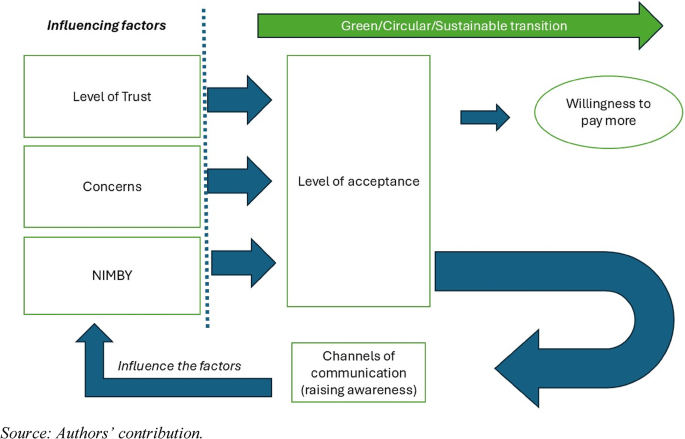 Additionally, it provides crucial insights for policymakers in understanding the barriers to the social acceptability of human-origin bio-based fertilisers. The results show that Swedish society leads the way in adopting this new solution. It was also clearly revealed that local municipality policymakers are best placed to promote adoption through local channels.
Download PDF
